We are looking forward to seeing Art DeCamp at the Tennessee Kentucky Rifle Show.
Showing posts with label Eric Kettenburg. Show all posts
Showing posts with label Eric Kettenburg. Show all posts
Wednesday, April 17, 2024
ERIC KETTENBURG RIFLE with an ART DECAMP POWDER HORN

Tuesday, July 26, 2022

Thursday, January 20, 2022
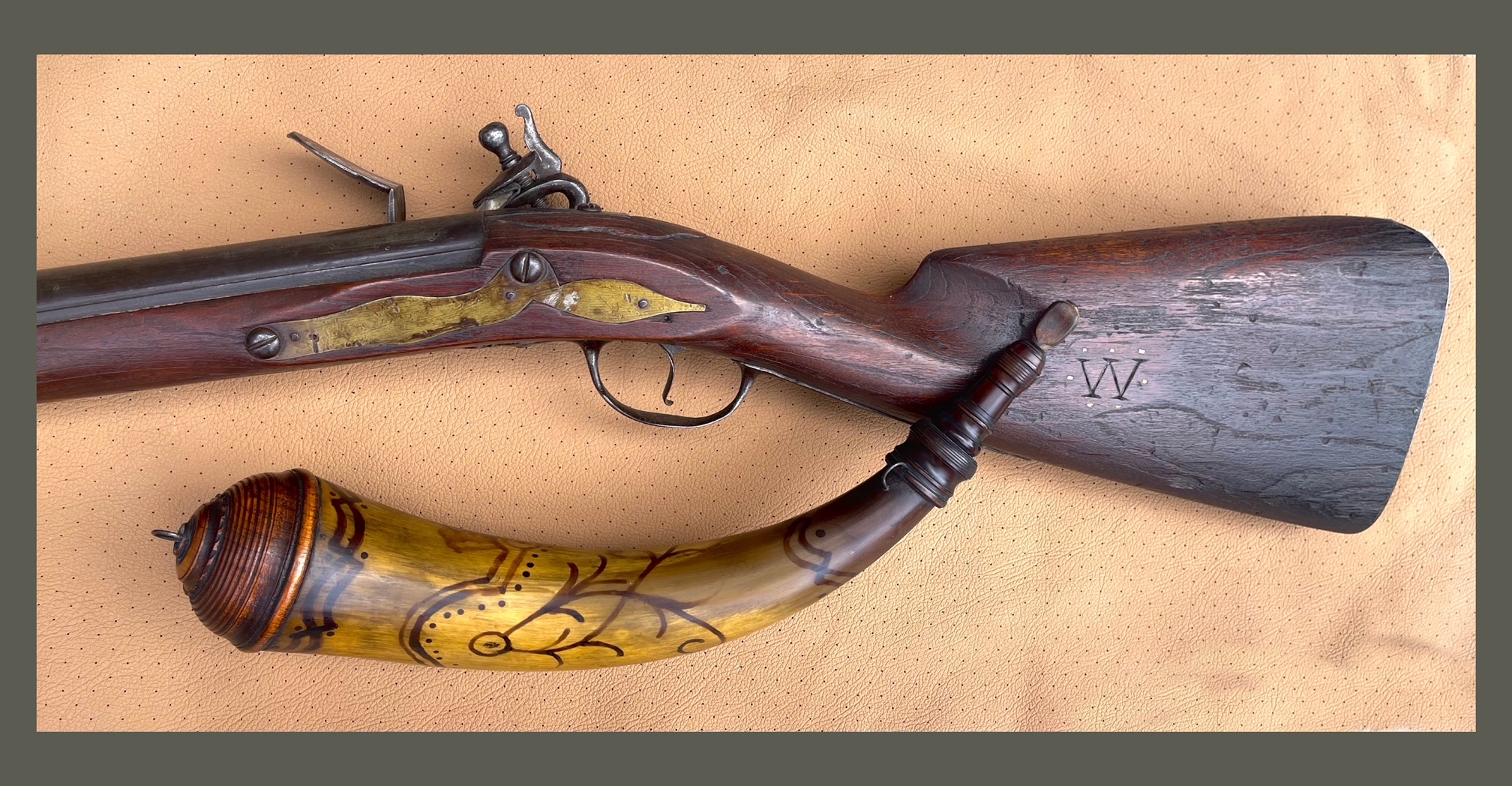
A Fowler by Eric Kettenburg with a Tall Tale

And now for the stereotypical story we all love to hear (and of course, wish would happen more often!): very old and very crusty, it was found in a closed-off space under the stairs in a dilapidated house prior to being torn down completely. I'm not sure exactly how old the house actually might be, but I did manage to track things backward to a bit prior to the Civil War. Going further would involve more work at the county courthouse that I've not accomplished yet. My suspicion is that this ancient warhorse was brought down from New England in the early 19th century, for this area of Pennsylvania saw a large influx of settlers out of New York and New England after the Revolution (down the Susquehanna River's north branch) and in fact was initially claimed by Connecticut until the point was settled via the brutal "Pennamite Wars" and their aftermath.
The stock is of cherry and overall the gun displays a large amount of use and repair as well as secondary work over the course of its lifetime. The box may be original, as it too is cherry, although the brass studs and inlay look to be more a product of the late 18th or early 19th centuries and surely were added by a previous owner. Despite evidence of considerable use, it was obviously maintained because missing or broken pieces of wood have been replaced fairly competently, if not perfectly matched. I'm not clear on when this may have occurred but it is definitely not more recent work. I'd define this large fowler as a 'parts gun' and it appears to be of New England origin as somewhat of a prototypical clubbed stock; while definitely slab-sided to some degree, it is more rounded than later pieces with well-defined slabbed sides.
The barrel is of at least .77 or .78 bore and is 56 inches in length, fully round with two side flats that are crudely relieved along their upper edges for the same length as the forearm (not the entire forend, in other words). There are no markings on it but it's a beast of a barrel with an extremely massive breech. The doglock has been identified as a Swedish martial lock that probably is a very early model 1716, but may predate this by a decade or two given some stylistic details. I'd feel comfortable dating the lock anywhere from ca. 1700 through 1720. How it got to the colonies is a bit of a mystery, as "Nessie" (a name bestowed upon this piece by a creative friend) probably dates to the 1720s or 1730s at latest, so the lock could not have been particularly old when it was recycled. Furthermore, scandinavian arms or parts of such arms were rarities here. Also present are a simple nailed-on sheet iron buttplate, a thin sheet brass sideplate and a recycled French musket guard of the late 17th century.


Powder Horn by Art DeCamp

Story and photography by Eric Kettenburg.
Photography of fowler with powder horn by Robert Weil.
Thursday, October 7, 2021
EARLY NEW ENGLAND MUSKET C. 1725 BY ERIC KETTENBURG

CHERRY WOOD STOCK
56 INCH RAYL BARREL, 10 GA SMOOTHBORE
ANTIQUE SWEDISH DOG LOCK
ANTIQUE FRENCH TRIGGER GUARD
HANDMADE BUTT PLATE, TRIGGER, SIDE PLATE, PIPES
HANDMADE IRONWOOD RAM ROD


Two full length photos by Eric Kettenburg and all others by Robert Weil.
Thursday, April 1, 2021


Monday, February 1, 2021
Eric Kettenburg on Gun Broker

Monday, January 18, 2021
Native buffalo/canoe gun 1830s by Eric Kettenburg

From Francis Parkman, The California and Oregon Trail, 1849.
"There are two methods commonly practiced, 'running' and 'approaching.' The chase on horseback, which goes by the name of 'running,' is the more violent and dashing mode of the two. Indeed, of all American wild sports, this is the wildest. Once among the buffalo, the hunter, unless long use has made him familiar with the situation, dashes forward in utter recklessness and self-abandonment. He thinks of nothing, cares for nothing but the game; his mind is stimulated to the highest pitch, yet intensely concentrated on one object. In the midst of the flying herd, where the uproar and the dust are thickest, it never wavers for a moment; he drops the rein and abandons his horse to his furious career; he levels his gun, the report sounds faint amid the thunder of the buffalo; and when his wounded enemy leaps in vain fury upon him, his heart thrills with a feeling like the fierce delight of the battlefield… The chief difficulty in running buffalo, as it seems to me, is that of loading the gun or pistol at full gallop. Many hunters for convenience' sake carry three or four bullets in the, mouth; the powder is poured down the muzzle of the piece, the bullet dropped in after it, the stock struck hard upon the pommel of the saddle, and the work is done. The danger of this method is obvious. Should the blow on the pommel fail to send the bullet home, or should the latter, in the act of aiming, start from its place and roll toward the muzzle, the gun would probably burst in discharging. Many a shattered hand and worse casualties besides have been the result of such an accident. To obviate it, some hunters make use of a ramrod, usually hung by a string from the neck, but this materially increases the difficulty of loading.”
 I defy you to find me more of a "PARTS GUN" than this!
"There are two methods commonly practiced, 'running' and 'approaching.' The chase on horseback, which goes by the name of 'running,' is the more violent and dashing mode of the two. Indeed, of all American wild sports, this is the wildest. Once among the buffalo, the hunter, unless long use has made him familiar with the situation, dashes forward in utter recklessness and self-abandonment. He thinks of nothing, cares for nothing but the game; his mind is stimulated to the highest pitch, yet intensely concentrated on one object. In the midst of the flying herd, where the uproar and the dust are thickest, it never wavers for a moment; he drops the rein and abandons his horse to his furious career; he levels his gun, the report sounds faint amid the thunder of the buffalo; and when his wounded enemy leaps in vain fury upon him, his heart thrills with a feeling like the fierce delight of the battlefield… The chief difficulty in running buffalo, as it seems to me, is that of loading the gun or pistol at full gallop. Many hunters for convenience' sake carry three or four bullets in the, mouth; the powder is poured down the muzzle of the piece, the bullet dropped in after it, the stock struck hard upon the pommel of the saddle, and the work is done. The danger of this method is obvious. Should the blow on the pommel fail to send the bullet home, or should the latter, in the act of aiming, start from its place and roll toward the muzzle, the gun would probably burst in discharging. Many a shattered hand and worse casualties besides have been the result of such an accident. To obviate it, some hunters make use of a ramrod, usually hung by a string from the neck, but this materially increases the difficulty of loading.”

Barrel is a .69 cal 1816 US musket barrel probably decommissioned and chopped ca. 1820s-1830s. Lock is a simple trade type lock, fairly large and stout with no internal bridle. The cock is a more recent replacement and the frizzen is a very old replacement with one heck of a stout sole/facing brazed onto it. I think the sole must be 1/8" thick at least, and while pan to frizzen fit is somewhat questionable, the lock sparks like crazy. *** Never reconverted! Neither lock nor barrel. ***. Frizzen screw is a newer replacement (with identical threads) to take up some slop but I do have the original frizzen screw although it's kind of useless. The lock now functions extremely well. Vent is still very serviceable but with 2F is somewhat self-priming; I would personally stick with 1F here. Bore was rough but has been slicked-up quite a bit and I have been having a HUGE amount of fun popping this off with light loads (@50 gr) and a naked undersized ball (.672) tamped with tow. Unless you are literally planning on running some buffalo, I'd call this one a "gong gun" now and keep it lighthearted with the loadings.


Contact Eric to discuss. kettenburgs@epix.net http://www.erickettenburg.com/
Subscribe to:
Posts (Atom)