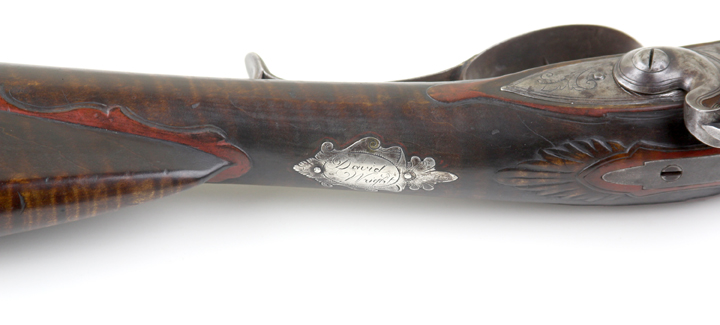
This is a Smoothbore Flintlock Fowler built by Samuel Atkins of Louisa County, Virginia. It is .60 caliber, roughly 20 gauge, and features a tiger striped walnut stock with German Silver hardware. Both raised and incised carving is evident as well as tasteful silver-wire inlays.
The gun represents a colonial stocked smoothrifle utilizing a mix of domestic parts along with salvaged French and English trade gun parts. The relief carving, moldings and panels are painted with varnish tinted with red oxide pigment.
Copy by Ian Pratt with photos by Ric Lambert, David Wright and Jane Wright.
Interesting American
Revolutionary War era musket with associated American and British parts, nicely
striped American walnut stock. The gun measures 56” overall with 39-1/2” barrel
of approx. .78 caliber smoothbore. The lock shows English Tower markings and
proofs as does the barrel. The trigger guard and buttplate are classic British,
with the buttplate showing some light engraving and a very early style. The
stocking is very American with no forend cap, no sideplate, forged iron
ferrules. The gun shows a crudely forged ramrod of the American style. The
metal surface shows light to heavy scattered pitting and erosion, heaviest
erosion occurring at the firing areas. There is some newer type rust and
remnant of a “24’ on the barrel which appears to be a regimental marking. The
stock shows an old break at the wrist and is repaired by screws. The stock also
shows some loses around the bottom edge of the lock opening around the
pin-holes. Many small dings and mars, but other than the repairs, generally
good. The lock is in its original flintlock configuration with the hammer screw
an old replacement. The mounts show a deep patina. The wood is without a doubt
American and of the 18th century and has a nice striped “Kentucky”
type look. Copy and image from Little John Auction.
When Robert Weil started collecting images for the Contemporary Makers book in 1973 the challenge to record contemporary gun work was daunting. Gathering material was difficult and time consuming. Few makers thought that there was any value in published documentation of their work. Electronic publishing has changed all that. Having a website or having one's work available to view on the internet is becoming a necessity. In spite of all the potential to finally have a true overview of what's being produced by the artists of today, a great deal of work still remains covered up and basically unknown. Our role is to make an effort to document some portion of what’s going on today. To comment on the established makers and to uncover the unknown. We welcome your comments and suggestions and look to you our readers to make us aware of the talented makers out there. Art and Jan Riser Robert Weil and The Makers