Showing posts with label Ward Oles. Show all posts

Monday, November 15, 2021

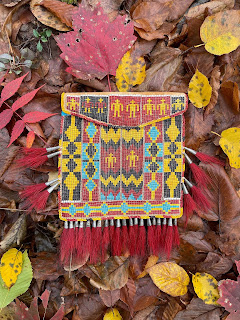
Reproduction Loom Quilled Bag by Ward Oles


Reproduction loom quilled bag c.1775. The original of this bag is housed
in the Pitt Rivers Museum, Oxford UK. This was a labor of love project
after first seeing the original back in 2010. Every detail of this unique
object was examined as closely as possible over the course of those
11 years in order to recreate a bag that was as faithful to the original as
humanly possible. It consists of 12 individual loomed panels sewn onto a
brain tanned bag and is fully lined. Every warp, weft, and quill had to be
sorted and carefully measured several times during prep work ahead of
assembly and while the panels were being constructed so that the
dimensions could be met consistently. The original has some damage
and a significant degree of fading in the lighter colored portions due to
he properties of original dye materials, age of the bag,  and storage
conditions. All of which were considered during planning and accounted
for in the finished piece. The most striking feature is the use of blue.
Blue as an natural indigenous dye material has not been identified in the
material culture of the northeast at the time, however blue derived from
boiling the color out of used textiles is. Production of indigo blue dye
from “worn green baize” is an established practice in the Great Lakes by
the period in question. This blue color is not at all uncommon in original
18th century quillwork ornamentation and can be found on dozens of
quilled objects. It was by the more well preserved objects that the colors
on this bag were extrapolated. 


Dimensions: 7.5”L (10”L w/ cones and hair) x 7.25”W


Materials: Dyed porcupine quills, dogbane and hemp fiber, silk ribbon,
tinned sheet iron cones, dyed deer hair, glass beads.
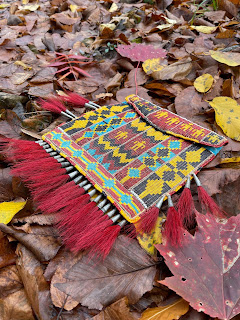
Copy and Photography supplied by Ward Oles.

Monday, January 11, 2016

Pipe by Ward Oles and Jan Zender

Bowl is by Ward Oles and the rest is by Jan Zender. The metal bits are from Jim Dressler's  collection.


Copy and photos supplied by Mitch Cook.

Sunday, April 13, 2014

Medals by Ward Oles


Mary of the Seven Sorrows

St. Anthony

St. Anne

Photos by Jan Riser.

Wednesday, January 22, 2014

Living with a Collection

 
Ax by Eric Schatzel, Gorget by Dave Hughes, horn by Scott and Cathy Sibley, Strap by Tom Condé, knife by Ken Gahagan and quilled pouch and Quaker medal by Ward Oles. 

Photo taken at Cades Cove by Mitch Cook.

Friday, January 10, 2014

Friday, July 12, 2013

Ward Oles, Tom Tom Condé and Scott and Cathy Sibley

Photo of the Ward Oles split pouch can be seen here.
Additional photos of the Tom Condé strap on the Scott and Cathy Sibley powder horn can be seen here.

Photo supplied by Mitch Cook.

Monday, December 31, 2012

Saturday, May 12, 2012

Otter Bag by Ward Oles

Mid-Late 18th century whole hide tobacco bag with netted quillwork. Some of the earliest collected examples of Eastern Native quilled material culture exhibit this netting technique. This bag is inspired by a number of similar otter tobacco and pipe bags with the fully netted legs and tail covering, as well as "loose" tail panels. The main inspiration for this piece is a similar bag housed in the University of Glasgow's Hunterian Museum. The bag is a "whole skin" brain-tanned otter hide, properly skinned through the neck per period examples, as opposed to the modern technique of "cased" skinning. This bag measures 57 inches in length overall. Over 2000 individually wrapped quills, 95 brass cones, 380 imitation wampum beads, and exact reproductions of original 18th century sleeve buttons and thimbles were required to complete this project.


Copy and photos supplied by Ward Oles.

Tuesday, January 31, 2012

Tobacco Bag by Ward Oles

18th century styled paint and panel tobacco bag 5"W x 14.5"L without fringe Created with design elements from a number of historic examples. Painted in geometrics and crosshatching using real vermillion and black ochre in a roe base as per originals. 

Copy and photos supplied by Michael Galban.

Sunday, January 22, 2012

Reproduction Beads by Ward Oles

18th cen repro full strand, some look like those currently available from the "African market" however the subtle difference is sets of 3 compound stripes and not the common 4 as with "modern" beads. Olive/ovilette, "dogbone", mulberry, twisted tube, and marvered included in this batch.

Graduated short strand...eventually I will get around to either making this a full matched strand, or adding "plainer" beads in between.

a really short strand of 17th cen types

Copy and photos supplied by Ward Oles of The Eastern Door.

Friday, October 7, 2011

Friday, August 12, 2011

Ward Oles Pipe


Photographed at the 2011 CLA Show by Jan Riser.

Monday, June 6, 2011

Tobacco Bag by Ward Oles with Strap by Eli Motsay


This is a recreation of a mid 18th century painted panel bag based on a number of examples including those in the Musee du Quai Branly, Paris; and the Arosen bag in the Deerfield Museum, MA. This type of bag had a wide geographic and cultural range of use from the East into the Midwest and up into the Northwestern Great Lakes region. The earliest known examples of this style of bag pre-date 1720. Many thanks are in order to Eli Motsay, Mike Galban, George Sluder, and Tom Connin for the inspiration and input into making this bag possible.

Dimensions: 18 inches overall length by 5 inches wide.  8 ply plaited strap made by Eli Motsay (length of strap 38 inches)

Materials:
Braintan deer skin
Porcupine quills
Deer hair
Tin and brass cones
True Vermillion
Black Ochre
Sucker roe

Copy and photo supplied by Ward Oles.

Thursday, February 10, 2011

Southeastern Pipes

Here are some pipes done in a Southeastern style. All are based on items attributed to the Cherokee, who traded pieces like these as far away as Maine to both Colonists and other natives. The material is a soapstone that was mined in Virginia, that same band pops up in western NC where the Cherokee sourced their stone. The effigy pipe is based off of a piece in the Warnock Collection. The others are patterned after artefacts from historic Cherokee towns,dug by the TVA before flooding the valleys and seriously damaging the integrity of the sites. Since my primary interpretation is that of a Cherokee warrior I have made an effort to preserve the memory of the reknowned pipe makers and offer a smoking piece ideal for any warrior, or person who had contact with native peoples in the backwoods. I have devoted considerable time to the study of the original pieces both in museums and texts, affording me the ability to re-create specific examples and offer interpretive works.

The other pipe is a piece by Ward Oles, included with his permission. Copied from an article in the British Museum, The curves of this pipe are what makes it and the others distinctively Cherokee. The material is also soapstone, but a finer grade than those mentioned above. All of the articles are made with a stone appropriate to the originals they are copies of. The finer stone of the original was possibly gotten in trade with northern peoples. 

A copy of the original pipe is included for two of the repros, posting them on the blog is considered fair use by their respective institutions.


Warnock pipe copy. I did deliberately make the face different on this pipe; I would not copy a mask.

Copy and photos supplied by Joseph Privott.

Thursday, September 9, 2010

Ward Oles War Club


Photographed at the 2010 CLA Show by Jan Riser.