Thursday, November 18, 2021

Wednesday, November 17, 2021

Shawn Webster for Joe Mills


Brad Mills primer

Shawn Webster measure


blade forged by Kenny Lutes from Winchester, KY
re handle by Joe Mills to fit his hand

Brian Barker ax


Shawn Webster strap

Photography by Jan Riser.

Tuesday, November 16, 2021

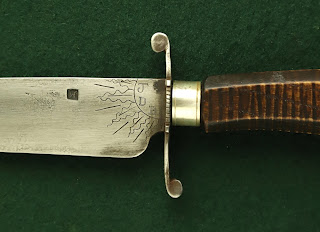
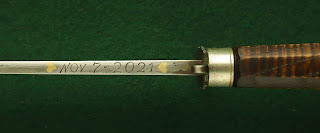
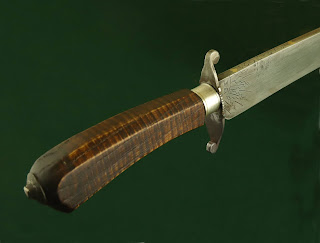
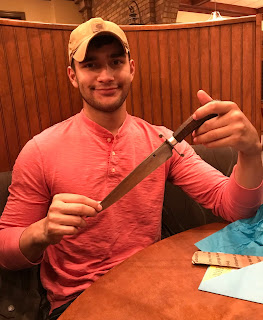
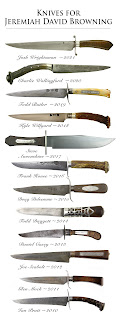
JOSH WRIGHTSMAN KNIFE FOR JEREMIAH “JAKE” BROWNING ~ NOVEMBER 7, 2021 AD


As part of a grandfather’s continuing tradition to his grandson, Jeremiah David Browning - this is the 12th handmade knife made by friends for his birthday. This year’s outstanding knife was made by talented knife maker, Josh Wrightsman, Russiaville, Indiana. Jeremiah received this knife for his 21st birthday, November 7, 2021.


Josh created a handsome knife with a hand forged blade with a curly maple handle with a poured pewter bolster. Continuing in the tradition since the first knife was made by Ian Pratt in 2010, two hearts are incorporated into the knife – this year, they are inletted in brass on the spine of the blade, flanking Jeremiah’s birthday – “Nov. 7, 2021”. And HDW and JDB is engraved on both sides of the blade. 


This is the 12th knife made for the continuing tradition from a grandfather to a fine grandson. Last year’s 2020 knife was made by Charlie Wallingford, 2019 knife was made by Todd Butler; 2018 knife was made Kyle Willyard; 2017 by Steve Auvenshine; the 2016 knife was made by Frank House, 2015 by Doug Delsemme; 2014 by Todd Daggett; 2013 - Daniel Casey; 2012- Joe Seabolt; 2011- Glen Mock; and the first, made in 2010 by Ian Pratt.


Thanks to all twelve of these special artists for making my grandson’s gifts extra special.


H. David Wright

Gallatin, Tennessee

November 14, 2021


Copy and photography supplied by David Wright.

Monday, November 15, 2021

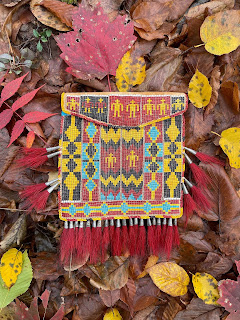
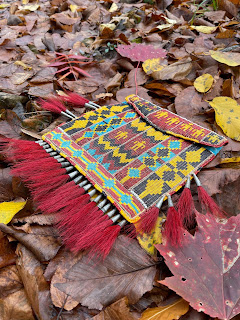
Reproduction Loom Quilled Bag by Ward Oles


Reproduction loom quilled bag c.1775. The original of this bag is housed
in the Pitt Rivers Museum, Oxford UK. This was a labor of love project
after first seeing the original back in 2010. Every detail of this unique
object was examined as closely as possible over the course of those
11 years in order to recreate a bag that was as faithful to the original as
humanly possible. It consists of 12 individual loomed panels sewn onto a
brain tanned bag and is fully lined. Every warp, weft, and quill had to be
sorted and carefully measured several times during prep work ahead of
assembly and while the panels were being constructed so that the
dimensions could be met consistently. The original has some damage
and a significant degree of fading in the lighter colored portions due to
he properties of original dye materials, age of the bag,  and storage
conditions. All of which were considered during planning and accounted
for in the finished piece. The most striking feature is the use of blue.
Blue as an natural indigenous dye material has not been identified in the
material culture of the northeast at the time, however blue derived from
boiling the color out of used textiles is. Production of indigo blue dye
from “worn green baize” is an established practice in the Great Lakes by
the period in question. This blue color is not at all uncommon in original
18th century quillwork ornamentation and can be found on dozens of
quilled objects. It was by the more well preserved objects that the colors
on this bag were extrapolated. 


Dimensions: 7.5”L (10”L w/ cones and hair) x 7.25”W


Materials: Dyed porcupine quills, dogbane and hemp fiber, silk ribbon,
tinned sheet iron cones, dyed deer hair, glass beads.

Copy and Photography supplied by Ward Oles.

Friday, November 12, 2021

Antique Powder Horn


Photography by Jan Riser.

Jan Riser Collection: Cloth and Costume 1750 to 1800 Cumberland County Pennsylvania


This book tells the story of how the people who settled in Cumberland County, Pennsylvania dressed and how they furnish their homes with textiles. Analysis of all 1,220 estate inventories filed in the county from 1750 to 1800, together with wills, deeds, administrative papers, tax lists, indictments, newspapers and manuscripts, give rich detail about the men’s and women’s clothing, bed “furniture” and table linen during these fifty years.

The appendices list over 100 named varieties of cloth found in inventories or stores.