May 1, 2013
The
blackpowder rifles that come out of Hershel House’s workshop hidden in the
Kentucky backwoods aren’t just exacting, made-from-scratch re-creations of true
frontier guns. The home-forged springs and screws, the hand-carved stocks, the
focus on function and reliability embody the history of America.
By
1780, the American frontier was changing. In Kentucky and Pennsylvania and
Virginia, in much of the old Ohio Territory and the big woods of Tennessee, the
baddest of the big game was largely gone. The eastern wolves that terrorized
the earliest settlements had nearly vanished, and so, too, the elk and bison.
Bear and mountain lion remained, and deer. But anywhere the ring of an ax was
heard, the report of the blackpowder rifle followed.
The
frontier had opened up. A man no longer needed a gun designed to hurl a
thumb-size hunk of lead into the nearest redcoat or hidebound predator or
painted Shawnee warrior. He needed a gun stingy with lead and easy to fix and
accurate enough to fill a bag with squirrels so he could feed all his kids who
busied themselves clearing trees for another field of corn. Once the scary
animals and natives were pushed from the verges of the American frontier, a man
no longer needed a big-bore thunderstick. He needed a rifle like the flintlock
Hershel House makes today, in the 21st-century hills of central Kentucky.
Wood, Iron, and Flame
Hershel
House is among the world’s most celebrated flintlock rifle makers. He
lives on a wooded knoll overlooking the broad Green River floodplain valley just
outside tiny Woodbury, Ky., where he was born and raised. His heavily timbered
property is littered with relics. Swages and coal forges crowd together under
shed roofs. Parts, pieces, and entire Model A’s are stored under soaring oaks.
His workshop is like a cluttered, narrow grotto, situated on the other side of
a dogtrot porch of a hand-hewn log cabin House has built over the last 15
years.
In
the mid 1970s, when the editors of the acclaimed Foxfire books
on Southern Appalachian heritage were looking for a rifle maker to profile,
they found their way to House and his tucked-away workshop. Since then, House
has built flintlocks for three Kentucky governors and for Fess Parker, who
played the title role in the old Davy Crockett TV series. He's
landed two National Endowment for the Arts grants to provide for gunsmith
apprenticeships, and restored the most credibly substantiated Davy
Crockett–owned rifle known to historians. That flintlock was "just a junk
pile" when he started, House says. It now hangs in the Tennessee State
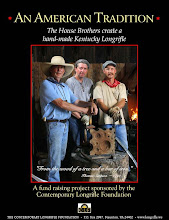
Museum. In 2009, House led a project—along with his brothers John and Frank,
celebrated craftsmen in their own right—to build a special-edition Kentucky
long rifle as a fund-raiser for the Contemporary Longrifle Foundation. Every
piece of metal was forged by hand. It raised $140,000.

House
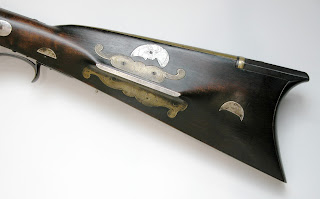
does turn out embellished guns, such as this double patch box southern mountain
rifle.
All
told, House has built some 300 pistols, shotguns, Indian trade guns, and both
flintlock and percussion rifles. And built does not mean assembled
from kits. In all cases, House forges the main components of the guns,
and in many cases, he has forged every single piece of metal down to the
springs. He's made highly embellished firearms that sold for better than $10,000,
although his last three rifles were simpler affairs that went for between four
and six grand. "I reckon I've got a name now," he says, grinning.
"Guys that bought those guns for $300 back in the '70s wish they'd held on
to 'em." In fact, House-made guns are so sought-after and valuable that he
himself owns but one.
Watching
House work helps tease apart the tangled genealogy of the American frontier
long rifle. The relationship between Kentucky rifles, Pennsylvania rifles,
mountain rifles, squirrel rifles, and Tennessee rifles—all somewhat loosely
applied terms—comes into finer focus. "They were all based on the big
German Jaegers," House explains, referring to the rifled-barrel flintlocks
brought by European immigrants that showed up in Pennsylvania sometime around
1709. Over the next hundred years the guns evolved into the fully stocked,
octagonal-barreled rifled muzzleloaders with the crescent buttplates that would
establish the reputation of both famous frontiersmen and a young nation itself.
Broadly speaking, the term Kentucky rifle refers to big-bore
guns built in the highly embellished style based in the Lancaster, Pa., region.
The Kentucky reference grew from a wildly popular 1826 ballad that celebrated
the feats of Kentucky hunters at the 1815 Battle of New Orleans. Later, a
shorter, heavier, larger-bore version—the Hawken rifle—showed up on the Western
plains.

House
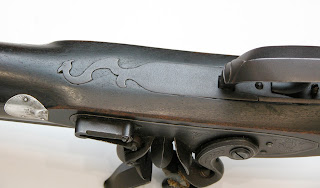
makes major metal components of each gun -- in some cases, every piece.
But
the rifle for which House is most recognized is a firearm more restrained and
straightforward than many carved and engraved Kentucky rifles. It’s a
.32-caliber squirrel rifle—a smaller, slender, subtler subspecies. Plainly
outfitted with iron mountings instead of polished brass, it was a gun common to
the frontiers of Virginia and the Carolinas from 1790 to about 1835. It is
simple and elegant and frightfully deadly, and seems as fitted to House and his
own life story as a hand-carved stock to a hand-forged patch box.
“You can see it here,” House says, bending
over a rifle that appears to be perhaps half completed. This current project—he
rarely works on more than one gun at a time—is a squirrel rifle for a customer
from California who has taken a number of House’s gunmaking classes. (House
leads multiday gun-building and knife-forging seminars from his Kentucky shop
several times a year; for details, contact him at 270-526-3493.) “A squirrel
rifle was sort of a fork in the road for the old blackpowder gunsmiths.” Once
the basic elements were in place—locks, stock, and barrel—gunmakers could
embellish the gun with elaborate carvings, engraved patch boxes, and highly
figured buttplates and other metalwork. Or they could produce a gun far more
suited to the evolving frontier edge.
By
the latter decades of the 18th century, two factors drove the development of
the squirrel rifle. First, the ornamentation of the earlier rifles was
considered a drawback for frontiersmen who relied on the guns to feed large
families. The engraved brass and silver mountings were expensive, and they
glinted in the woods, scaring game. Squirrel rifles instead used iron fittings
easily forged and fixed in the backcountry. The patch box itself was something
you could do without, and save a few cents. A channel was carved into the stock
for storing tallow for patch lubrication.
“On
an earlier gun,” House explains, pointing to the gunstock just behind the lock,
“they would carve a raised, ornamental panel called a beavertail right here.
But you get into these squirrel rifles and those penny-pinching mountain folk
didn’t want to put on airs with a fancy rifle. Some didn’t even have
buttplates. They wanted the gun to be good and deadly. And if they didn’t have
to have it, they didn’t want it.”
House
has blue eyes set in an angular face like a hatchet, and a thick Beatle-like
mop of brown hair despite the fact that he turned 70 years old last July 4. As
he works a fine rasp between the lock panel and the stock’s wrist, sawdust
falling like fine snow, House talks. After the American Revolution, “powder was
hard to get and expensive, and lead was tougher to come by.” By making smaller
guns, you used less lead and powder. “A .32-caliber squirrel gun would still
kill a man if you hit him just right. And it would definitely kill a deer or a
wild hog. But times were awful hard. I’ve read of guys that would shoot a
squirrel in a tree then take their tomahawks and dig the bullet out and chew it
back round to use it again. That’s how valuable the lead was.”
The
squirrel rifle enabled hunters to forage the quickly civilizing edge of the
western frontier, a place shifting rapidly from utter wilderness to a kind of
prototypical suburbia. And that’s why American frontiersmen became such
noteworthy marksmen. Game was getting scarce; lead was expensive. Every time
you pulled the trigger, it had to mean something.
Which
is why a rifle like the one that House makes will tell you the story of
America.
Afield With the Smith
Varmint!
House in the squirrel woods near his workshop.
You
can tell when House is hunting because he will have a powder horn and bullet
pouch around his neck and his squirrel rifle in the crook of his arm.
Otherwise, he might look as though he's simply on the way to the forge or the
post office. There's no fuss about it. Hunting is seamlessly integrated into
the warp and weave of House's life—off for an hour or two after chores, before
the sun goes down, him and his dogs. He wears jeans and running shoes, a
green-and-black plaid jacket, a grimy Red Man ball cap—what he's been wearing
all day in the shop. He whistles up Liddy and Fred, and steps off the cabin
porch, and he's hunting. "Come on, let's go, find us some varmints,"
he sings out as the dogs prance and pee. It's a term House tosses about frequently—varmints—and
I never quite figure out if it refers to squirrels, anything but squirrels, or
everything including squirrels. Whatever shows up, though, opossum or raccoon
or rabbit or squirrel, is likely to get shot, and just as likely to wind up in
a black iron stewpot.
Now
Liddy and Fred streak after a rabbit jumped from the crown of a blown-down oak.
They lose the rabbit before they can put on a good race, but House is
unperturbed. He moves through the woods with a casual pace, eyes on the branches
overhead, letting the dogs do their work. I follow behind, watching House cap
out on winter-bare ridgetops, with soaring views of the corrugated, folded
Kentucky countryside unfurling across the Green River. At one point he is
silhouetted against the sky, framed between the squat outlines of his home and
shop, with open fields butting up against towering oaks. It’s a scene right out
of the flintlock days, when a cabin and a rifle were all that kept the
wilderness at bay.
House
felt this pull of old frontier life as early as his own childhood. Growing up,
he made his own coonskin caps and hunted long and hard and often alone. “I
didn’t know anybody else cared about the old stuff,” he says. In the mid 1950s
he found an old half-stocked squirrel rifle in the barn of a family friend. He
fixed it up and started laying the squirrels out with round lead balls. Within
a few years later he’d saved up enough money to order a barrel and a few pieces
of hardware from Dixie Gun Works. Everything else he “beat out” on a forge. It
was an experience that introduced him to a world he didn’t know existed. “When
I found that Dixie Gun Works catalog,” he says, “I thought, Man, maybe I’m not
the only crazy person out there.”
After
a brief stint in the U.S. Marines, House returned home to Woodbury and set up
shop as a full-time blackpowder rifle maker. At first, it was hardly a
lucrative business. It would be a long time before blackpowder hunting would
reach the mainstream, and even today, hunting with a rock-lock is a curiosity
at best. One day a few years back House was squirrel hunting along the ridge
behind his house and ran into a deer hunter who hollered out, “What are you
doing with that stupid rifle? You can’t kill nothing with that old thing!”
House
snapped back. “What do you think happened to the original deer herd in these
parts, boy?” he said, patting his flintlock. “Guns like this old thing—that’s
what!”
After
the hunt, we head to House’s kitchen, where he piles plates with white beans
and ham hocks and fried hoecakes made from cornmeal he ground himself. Shelves
of a hutch cabinet are warped with the weight of a hodgepodge of put-up
vegetables and deer meat, cans of rifle powder, and old blue-ware china. There
are stacks of books on colonial history, biographies of Daniel Boone, and
scholarly tomes on bayonets and antique engines.
This
allure of the ways of old permeates every aspect of House’s craft, and his
approach to gunmaking has evolved into a distinguishable style whose warm, soft
lines now define what is known as the Woodbury School. He “browns” a gun’s
metal parts by boiling them in a bleach-and-water solution that pepper-rusts
the metals. “It gives them that lightly pitted look that breaks up the glare,”
he explains, “and softens the corners and hammer marks. It makes them look like
an old rifle that has been taken care of but still used good and hard.” He
prepares gunstock stains from an old recipe—horseshoe nails and iron filings
dissolved in nitric acid—and uses heat to drive the mixture deep into the wood.
When
he first started making these guns, “I caught hell for it,” he recalls. “People
said I was building fakery guns, that a new gun ought to look like a new gun.
But I kinda like it, and it turned out that a whole bunch of other folks kind
of liked it, too. So I’m glad I never listened to those folks.”
Given
his love of blacksmithing and knifemaking and old engines and stone-ground
meal—even the Model A’s that he drives all over Kentucky’s Butler County—it
might be easy to think that Hershel House is a man living in the wrong era. But
his realistic grasp of those bygone days, and their difficulties, turns aside
such romanticisms.
“I
get that a bunch,” he says with a grin, and shakes his head. “Everybody says I
ought to have been born 200 years ago. But it was too hard a time back then.
Little kids dying of pneumonia. Indian wars. Maybe I would have survived more
so than a lot because I have a familiarization with the long rifle. But it’s much
more fun to play that role now than it would have been to live it.”
Making Frontier Meat
In
the morning, House sends me out on my own. Fog hangs low in the valley. I have
his squirrel rifle in my hand, his hand-carved powder horn, powder charger, pan
primer, and ball loader on a leather thong around my neck. The woods at dawn
are crawling with squirrels. Within 45 minutes I miss four. I miss squirrels
stretched out on the trunk of a beech tree and balled up in the crook of a
poplar and feeding in the twiggy boughs of a pine. I miss them from 60 feet to
150. Try as I might, that flash in the pan, the smoke and sizzle-puff and the
brief hesitation between the pull of the trigger and the blast of the powder is
just disconcerting enough that my aim can’t quite hold.
I
reload carefully. Pull out the wooden powder-horn plug with my teeth. Fill the
powder charger that holds the correct load. Replace the horn plug. Pour the
powder down the barrel. Place the bullet loader with its patched balls over the
muzzle. Ram a bullet home. Replace the ramrod. Put the gun on half cock. Pour
powder from the flash powder horn into the concave dip of the flash pan. Set
the flash guard against the powder. Ready. As I am shaky with the process and
trying to hide from squirrels, this takes approximately three minutes. One
thing’s for sure—I’d have been picked off by a redcoat or a warring native long
ago.
I
have done this since I was a child, slipped along slowly below the crest of a
hill, eyes open, heart pounding at every little twitch of a twig or limb. I’ve
killed squirrels with shotguns, with rifles from boats in swamps, killed them
with Cajuns, killed them over squirrel dogs and over the gunwale of a canoe.
But I’ve never tried to kill one this way, the way that sustained America, with
a flintlock rifle in hand.
Now
another squirrel is headed my way, and I bury my left shoulder into the pale
bark of a beech. Hugging the tree, I peek around. He’s headed for a pine and I
know why. I can see the nest. He stops and hesitates, like a deer looking over
its shoulder, and I touch the double-set hair trigger.
This
time, after the flash, the squirrel tumbles through the smoke, hits the leaves,
and lies still as a stone. I stifle a whoop of glee but can’t help but
fist-pump in a very un-pioneer-like fashion.
In
the end, one squirrel out of five opportunities won’t make me a Kentucky
rifleman. But it will make me what Kentucky riflemen have sought with a
squirrel rifle since the days when America was just a dream. It’ll make me a
fine supper.
Copy and photos from Field and Stream Magazine here.