Showing posts with label Mark Elliott. Show all posts
Friday, November 15, 2019
Tuesday, March 26, 2013
Iron Mounted Southern Longrifle by Mark Elliott
Stock: Moderately curly, slab cut, red maple
Lock: Chambers Late Ketland lock
Barrel: 42”, 45 caliber, B weight swamped barrel by Getz
Mounts: All iron/steel with a hand forged butt piece and guard
Triggers: Davis longrifle double set triggers modified to fit the guard
Length of Pull: Approximately 13 1/2 inches
Drop: Approximately 2 3/4 inches
Cast-off: Approximately 1/4 inches
Butt piece height: Approximately 4 1/2 inches
Butt piece width: Approximately 1 3/4 inches
More photos of this rifle and copy about Mark's process can be found here.
Copy and images supplied by Mark Elliott.
Saturday, February 5, 2011
Fraktur Bookmarks and Bookplates by Mark Elliott
I have long had an interest in fraktur and have been doing fraktur type decoration on various objects, but I recently decided to try my hand at real fraktur documents. I started with bookmarks and bookplates as I needed something appropriate for my hand bound, leather covered 1733 New Testament from the Bible Man. The bookmarks are all hand drawn, hand inked, and hand colored, on 3" x 5" cold press watercolor paper. They are little works of German folk art.
Copy and photos supplied by Mark Elliott.
Monday, May 24, 2010
Mark Elliott Early Virginia Shot Pouch
Most of the hunting pouches made these days are relatively complicated affairs using designs from the early to middle 19th century. If you want a bag that is proper for the 18th century, take a close look at this bag.
Copy and photos supplied by Mark Elliott.
There are very few examples of hunting pouches from the 18th century. So, I was fortunate to be able to study an original early Virginia pouch that matches the size and construction of another published (Clash of Empires exhibition catalog, p. 30) pouch known to date to the period of the French and Indian War. This original Virginia bag was documented by Wallace Gusler in the December 2009 Muzzle Blasts(pp. 4-8).
The original one piece pouch is square at the bottom (although the corners look rounded due to use) and stitched up the sides with a very fine stitch very close to the edge. A divider that is open at the bottom serves as a welt between the front and the back of the bag. A pewter flap button is anchored to a stag horn button on the inside of the pouch. The stag horn button was covered by a round piece of leather that served to prevent the user's hand from catching on the button. The flap extends approximately halfway down the front of the bag and has a slight beaver tail shape with a welted edge.
The original bag did not have a strap attached and was missing part of the leather at one attachment point. However, there was evidence of a strap stitched to one side and a button hole on the other side. Wallace Gusler indicated in his article that he believed two linked buttons (as in a cufflink) connected the strap to the bag using the button hole.
I have made a number of hunting pouches based on this original. I have generally maintained the size and shape but varied the construction (i.e. external vs. internal stitching), the type of strap (i.e. leather vs. woven) and the type of attachment (i.e. location and number of buttons) for the strap. The original pouch actually appears to have rounded corners due to wear, and I made several copies that way before I realized that it was an optical illusion. Even in this very close copy, I still rounded the corners slightly in order to give the bag a finished look.
Not having Russia leather which was most likely used to create the original, I created my copy of the original using 3-4 oz. vegetable tanned cowhide which I stained using vinegar and iron. This particular bag is just about the same size as the original at approximately 7.25" wide X 7" high. Just like the original, this pouch has a center divider as the welt and is stitched up the sides. I rolled and hemmed the edge of the flap instead of using a welted edge because of the thicker leather that I use. I maintained the same flap button attachment as the original with a stag horn button used as an anchor for a pewter flap button with a leather cover sewed over the internal stag horn button.
As for the strap, I attached it in a manner as close to the original as I could ascertain. One end of the strap is stitched to the right side (as worn on the right side), and the other end is attached to the bag using a single small pewter button anchored to another small pewter button on the inside of the pouch. The strap may then be seasonally adjusted using buttonholes in the end of the strap. I have punched four buttonholes for about 4" of adjustment.
The original pouch was decorated with stamped stars. Consequently, I made a matching stamp and decorated my pouch in a similar manner, only adding diagonal lines reminisent of English checkering patterns.
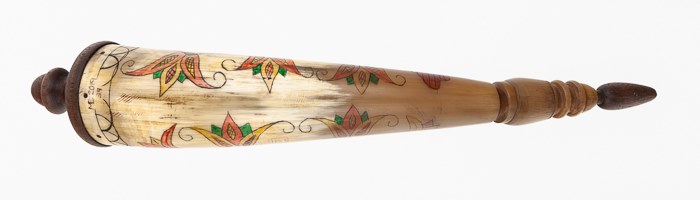
I attched to the bag a Virginia banded screw-tip horn that might have been available in the Valley of Virginia as early as the French and Indian War. The horn is approximately 15" around the outsite curve with a 2 3/4" base plug. The base plug and stopper are turned walnut with the base plug attached with wooden pegs. The screw-tip and band are horn. The screw-tip is dyed to match the walnut. Hand forged staples are installed in the the base plug and throat for the attachment of the hangers. The hangers are attached to the bag strap with buttons just as the strap is attached to the bag. The horn is dyed yellow with aquafortis and appropriatedly aged.
As with all my recreated pouches and horns, I try to made them look used. That means adding wrinkles, puckers, a few cracks, some stains and blemishes, and a bit of dirt and oil. I try not to overdue it so that the function of the bag is compromised.
You might think that this bag is too small at about 7" square. I can assure you that it is not. Period documentation indicates that most longhunters carried hunting pouches of this size. They would just carry what they needed to shoot the gun. This generally meant a bullet mould, some bullets, patches, tow, and a wiper. A powder horn and powder measure with a vent pick and brush were generally hung from the strap.
In my bag, I keep some tow, a strip of pre-lubricated pillow ticking, five balls, two flints wrapped in leather, and a turn screw of some sort. This bag is plenty big for that. I hang a pan brush, vent pick, and powder measure from the pouch strap. I carry a power horn on a separate strap, and I hang a small knife around my neck in a neck sheath. This is certainly all you need for a day of hunting and more than you need to carry to the line when shooting at the range.
Copy and photos supplied by Mark Elliott.
Friday, February 26, 2010
Carved Early Virginia Chunk Gun by Mark Elliott
I made this rifle in 2005 for a friend. The title here as well as the gun is a bit anachronistic. There was no such thing as an early Virginia chunk gun. Chunk guns were a product of the mid and late 19th century. However, my friend wanted a chunk gun in a Hershel House early Virginia style. As the project gave me an opportunity to try a few new things such as a captured patchbox and poured pewter nose piece, I gladly took on this project.
For those of you not familiar with chunk guns, a chunk gun is a traditional style longrifle with a particularly long and heavy barrel designed specifically for target shooting. Chunk guns are shot over a log or "chunk" while laying on the ground. They are shot at a target 60 yards away. You take 10 shots and add up the distances between the center of the bullet holes and the center of the bulls-eye. The shortest total distance wins.
This particular gun has a typical early Virginia profile and uses a butt piece and guard castings made off a Hershel House rifle. The captured patchbox, side plate, poured pewter nose piece, and cheek side carving are based on Hershel House's interpretation of an early Virginia rifle as documented in his videoBuilding a Kentucky Rifle published by American Pioneer Video. While Hershel normally uses a beaver tail around the tang, I thought that an acanthus leaf/fleur de lise design went better with the raised carving behind the cheek piece. I spent more time on the carving and engraving than I probably should have for such a utilitarian rifle.
As to the nuts and bolts, the rifle has an 1 1/8", straight, 44 inch long, 54 caliber Rice barrel. A White Lightning liner is installed. The lock is a Chambers Early Ketland with a pan bridle. The set triggers are by Davis. The stock is a piece of curly cherry. The stock is entirely scraped and burnished and the rifle is generally finished in a workman like manner. The stock was stained with a lye solution and finished in oil. I have applied a patina to the metal parts to simulate a good number of years of gentle use.
The technical details:
Stock: | Curly Cherry |
| Lock: | Chambers Early Ketland |
| Barrel: | Rice 44", 54 caliber, 1 1/8" straight with Chambers White Lightning liner |
| Trigger: | Davis double set triggers |
| Mounts: | Butt piece and guard cast from original Hershel House mounts, rest of mounts from brass sheet. |
Copy and photos supplies by Mark Elliott.
Monday, August 10, 2009
Mark Elliott
1775-1785 Augusta/Rockbridge County, Virginia Rifle
This is a 1775-1785 Augusta/Rockbridge County, Virginia rifle based on the two rifles documented by Wallace Gusler in the Journal of Historical Arms Making Technology, Volume II (JHAT II). The patchbox and its engraving is an original design extrapolated from the boxes on the guns documented in JHAT II as well as those by John Davidson. The lock is a Chambers Early Ketland, filed, polished and engraved in a manner typical of most imported English locks with heat blued screws.. The 50 caliber, 44" long, Bivens profile Getz barrel is polished amory bright. A White Lightning liner is installed. The rifle has modified Davis double set triggers that have been heat blued. The butt piece and guard are neatly filed from yellow brass castings from Reeves Goehring. The rest of the mounts, including the one piece nose piece, are hand made from sheet brass. The stock is carved from a blank of very curly, stump cut, quartersawn, hard maple from Freddie Harrison. The barrel is hand inlet using gouges, period gunstock planes, and rasps. The stock is entirely scraped and burnished and the rifle is generally finished in a workman like manner. The forearm moulding and buttstock moulding were cut with a custom made scratch stock in the original manner and show the characteristic ripple from scraping very curly wood. Period correct tools and techniques were used with files, rasps, chisels, and planes being used for most of the work.. The stock is stained with aqua fortis and finished in oil. I have fitted the scraped hickory ramrod with a plain sheet steel ferrule on the breech end that accepts a hand turned wiper made for the rifle. The wiper is in the patchbox.
This rifle was awarded a Judges choice ribbon in the Master class at the 2009 Dixons Gun Makers Fair.
Copy and photos supplied by Mark Elliott.
Monday, July 20, 2009
Southwest Virginia Rifle by Mark Elliott
This is a fully iron mounted gun of the late flint period that I made in 2004 as my personal offhand target rifle. It has features found on rifles from Rockbridge County into Southwest Virginia and Eastern Tennessee, but is of a style mostly of my own creation. It has a hand forged butt piece and guard, and all the other mounts are hand made from steel sheet. The barrel was browned. The lock was polished and aged, and all the other mounts were blackened and aged. The 40 caliber, straight, Green Mountain barrel is 13/16" across the flats and 42" long. A White Lightning liner is installed. The lock is a Chambers Late Ketland. The rifle has Davis double set triggers. The stock is a piece of moderately curly, quartersawn, red maple. The stock is entirely scraped and burnished and the rifle is generally finished in a workman like manner. The stock is stained with aqua fortis and finished in oil. I have fitted the hickory ramrod with a plain sheet steel ferrule on the breech end that accepts a hand turned wiper made for the rifle.
The technical details:
Stock: | Moderately curly, quartersawn, Red Maple |
| Lock: | Chambers Late Ketland |
| Barrel: | Green Mountain 42", 40 caliber, 13/16" straight with Chambers White Lightning liner |
| Trigger: | Davis double set triggers |
| Mounts: | Hand forged steel and steel sheet |
Copy and photos by mark Elliott. More of Mark's work can be seen at his web site.
Monday, January 12, 2009
Mark Elliott Early Virginia Rifle
This is an early Virginia rifle that I made in 2004 as part of a class I took at the NMLRA Gunsmithing Workshop. Rather than being based on a particular gun, it is encompasses the features of several pre-Revolutionary rifles from the Valley of Virginia. The cheek side carving is based on work from Rockbridge and Augusta counties in the central Valley of Virginia. The tang carving is typical of the Winchester area. It employs butt piece and guard castings from Reaves Goehring. All the other mounts and hardware are hand made. The rifle has a 42 inch, 54 caliber, C weight, Colerain barrel. A White Lightning liner is installed. The lock is a Chambers Early Ketland. The stock is a piece of fairly curly, slab cut, red maple with the grain running nicely through the wrist. The stock is entirely scraped and burnished and the rifle is generally finished in a workman like manner. The stock is stained with aqua fortis and finished in oil. I have fitted the hickory ramrod with a plain sheet steel ferrule on the breech end that will accept a 10-32 threaded wiper. M.E.E.
The technical details:
Stock: Fairly curly, slab cut Red Maple
Lock: Chambers Early Ketland
Barrel: Colerain 42", 54 caliber, C profile with Chambers White Lightning liner
Trigger: Hand forged single trigger pinned in stock
Mounts: Cast brass butt piece (early butt piece from Dixie) and guard (Reaves Goehring #10), rest of mounts from brass sheet.
More of Marks' work can be seen on his web site.
Photos supplied by Mark Elliott.
Subscribe to:
Posts (Atom)